

Have you ever taken a moment to calculate how much time, effort, and emotional energy you spend simply trying to manage, quiet, or pacify your own mind?
Throughout our lives - regardless of our age, social standing, or the milestones we achieve - we remain caught in a subtle, continuous struggle to keep our minds content. From childhood into adulthood, much of our life is spent negotiating with our internal thoughts, trying to satisfy their endless demands, or attempting to steer them away from worry and doubt. Yet, despite decades of effort, the mind is rarely, if ever, truly satisfied. It wanders continuously, grows bored easily, and repeatedly pulls us into unnecessary stress, trivial arguments, and endless internal chatter.
If attempting to control, entertain, or please the mind hasn't brought you lasting peace, it is time to embrace a foundational teaching of authentic Yoga: You cannot quiet the mind on the level of the mind. To find true liberation, you must learn to transcend it.
At Yoga Base, we look beyond superficial fixes to address the root of mental restlessness, offering a structured path to step beyond thought and anchor yourself in lasting inner stillness.
The Illusion of Satisfying the Mind
To understand why traditional coping mechanisms often fail, we must first look at how the mind (manas) operates by default.
In yogic philosophy, the mind is inherently restless (chanchal). It is designed as an interface between our inner awareness and the external world. When the mind projects outward through our five senses - eyes, ears, nose, skin, and tongue - it is constantly hunting for new stimulation, fresh topics, and novel experiences. It craves change.
However, external novelties inevitably wear off. The moment a new experience becomes familiar, the mind loses interest, leading to boredom, mental fatigue, and an immediate urge to jump to the next distraction. This creates an exhausting cycle:
Desire for Stimulation -> External Pursuit -> Temporary Satisfaction -> Boredom -> Restlessness
When we experience physical ailments, we usually have straightforward remedies - rest, medicine, or physical therapy. But when the mind experiences turbulence, remedies are far harder to find in the external world. Most people default to passive distraction, scrolling endlessly through media, or seeking refuge in sleep just to get a temporary break from their own thoughts. But sleeping or distracting yourself doesn't solve the underlying problem; it merely pauses it. The moment you wake up, or the distraction ends, the chatter resumes.
The Yogic Approach: Transcending Thought
If pleasing the mind is an impossible task, what is the alternative? Authentic Yoga teaches us that instead of trying to manipulate or alter the contents of your thoughts, you must change your relationship to thought altogether. You must learn the art of going beyond (transcending) the mind.
When a practitioner comes under proper guidance and begins to explore deeper yogic practices, they start to question the restless habits of their thoughts. They begin to realise that peace isn't achieved by winning an argument with the mind, but by stepping out of the arena entirely.
Going beyond the mind means shifting your identity from the chatter to the observer of the chatter. It is the realisation that you are not your thoughts; you are the silent, aware presence behind them.
The Three Pillars of Inward Transformation
At Yoga Base, the journey from mental chaos to inner stillness is built on a systematic, time-tested approach. Transcending the mind isn't a matter of wishful thinking; it requires physical, energetic, and mental preparation.
1. Physical Steadiness (Asana)
Your journey inward begins with the body. There is an intimate, bidirectional link between physical movement and mental activity. A restless mind creates a fidgety body, and a moving body keeps the mind active.
Learning the art of sitting motionless (Asana Siddhi) breaks this cycle. When you train your body to sit still without constant shifting, scratching, or adjusting, you send a direct signal to your nervous system. By eliminating physical movement, you strip the mind of its easiest outlet for internal restlessness, forcing it to settle down.
2. Focused Concentration (Dharana)
Once the body learns to be still, the mind’s scattered energy must be collected. Naturally, mental energy flows outward in a dozen different directions at once.
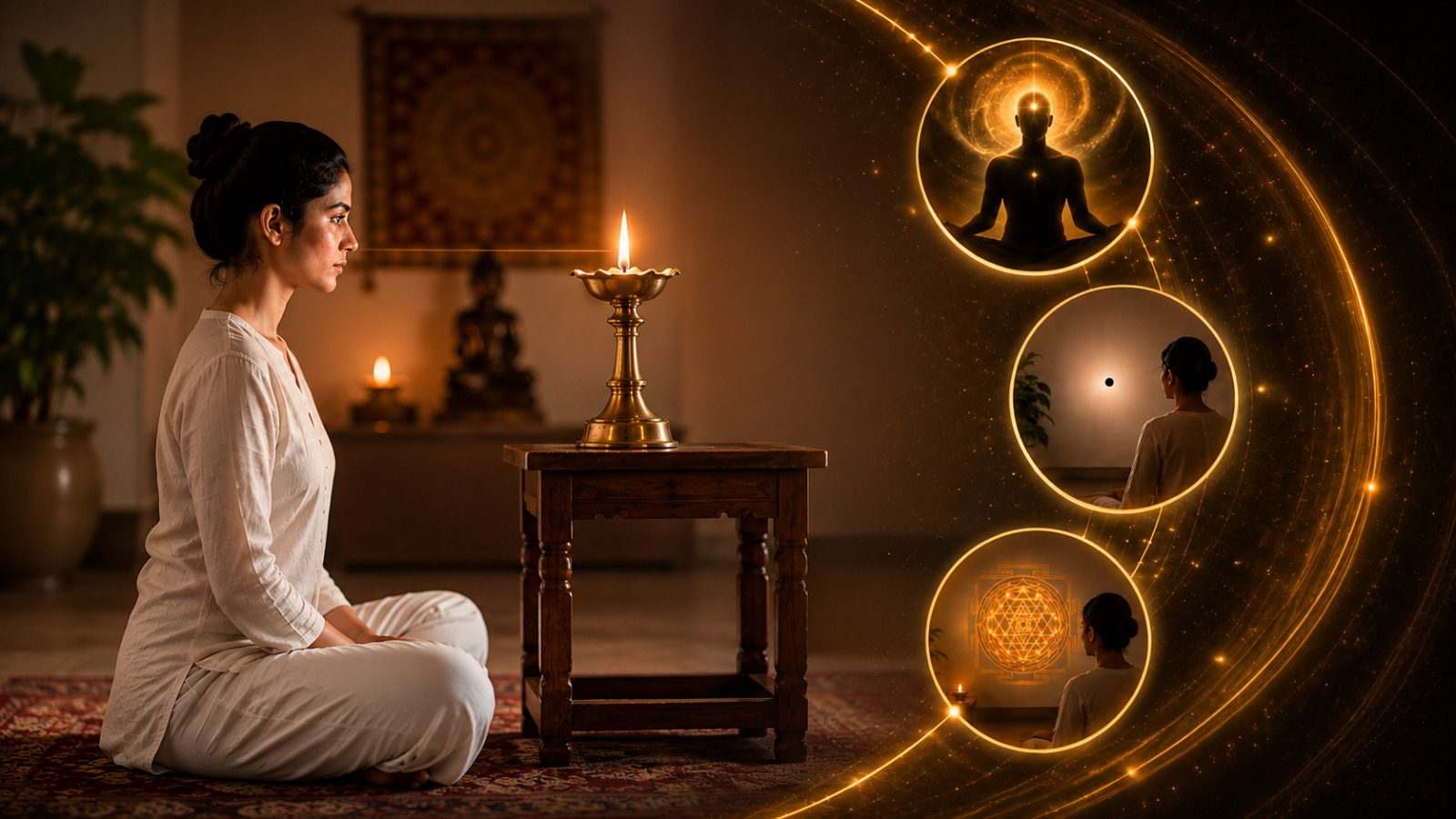
Through Dharana (concentration), we train this outward energy to anchor onto a single point of focus - whether that is the flow of the breath, a central focal point, or an internal visual. By giving the mind a single, stable anchor, we calm its chaotic momentum and prepare it for deeper, undisturbed states of awareness.
3. Experiencing Inner Resonance (Dhyana)
As physical stillness and focused concentration take hold, a natural shift occurs: the mind turns inward (Pratyahara).
When the mind stops seeking external stimulation and gazes inward, it begins to experience subtle, divine waves of energy within the body. Practitioners often describe this stage as a deep sense of warmth, light, or rhythmic internal stillness. This internal resonance unleashes an authentic source of joy and fulfilment that far surpasses any fleeting pleasure the external world can offer.
From Restless Seeker to Centred Master
When the mind encounters this deep internal bliss, a profound transformation occurs. Its habit of chasing external noise, engaging in petty arguments, and clinging to worldly drama naturally dissolves. It no longer needs to hunt for entertainment because it has discovered a far richer experience within.
The mind - which was once your greatest source of agitation - transforms into your most powerful collaborator on the path to self-realisation.
Mental Disconnection -> Outward Searching -> Inner Stillness -> Self-Mastery
By stepping beyond mental chatter, a practitioner shifts from a state of constant internal conflict (Sadhak) to becoming a steady, centred master of their own inner state (Siddha). You begin to navigate daily life with clarity, emotional stability, and an unshakeable core of peace.
Practical Tools: Incorporating Stillness at Yoga Base
To bridge the gap between abstract philosophy and your daily life, Yoga Base offers practical, structured methods to guide your practice:
- Postural Alignment & Stillness: Guided sessions designed to help you build comfort in seated posture so you can sit effortlessly without distraction.
- Pranayama (Breath Control): Specific breathing techniques designed to smooth out the nervous system and directly calm brainwave activity.
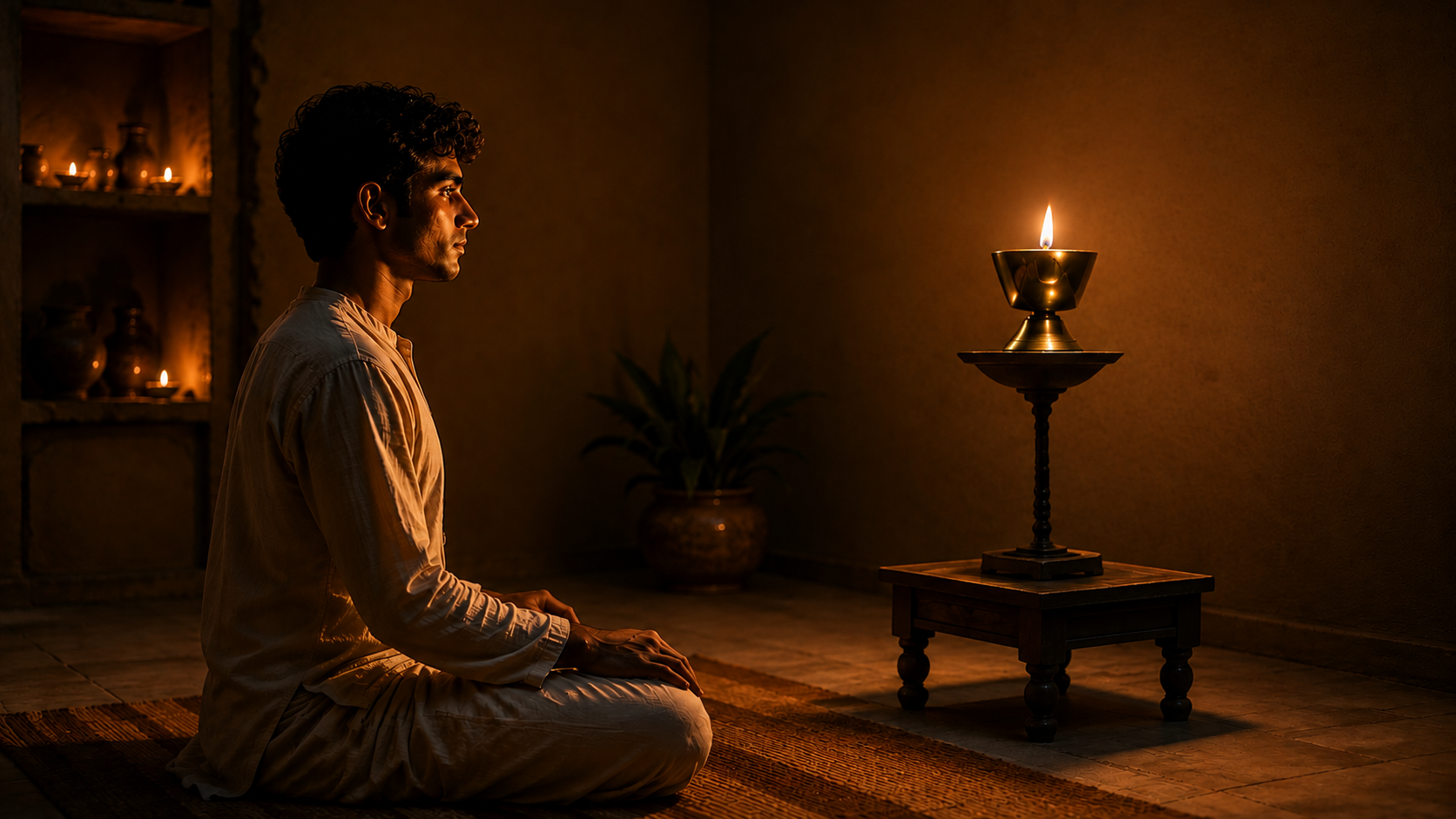
- Gaze Concentration (Tratak): Direct focus practices that still the optic nerve, quiet bodily fidgeting, and bring wandering thoughts to a complete halt.
You don't need to struggle with your thoughts for the rest of your life. By building a solid foundation through authentic yoga, you can cultivate a quiet mind, a healthy body, and an enduring sense of inner freedom.
Build Your Foundation with Yoga Base
Are you ready to go beyond the noise of the mind and experience genuine inner peace? Explore our beginner and advanced yoga and meditation programs at Yoga Base today, and take your first step toward mastering inner stillness.